Where US immigrants come from, and where ICE focuses enforcement
Bad Bunny's Super Bowl halftime show highlighted the Americas. Here's what the data shows about immigration and enforcement patterns.
Last night, Bad Bunny performed the first primarily Spanish-language Super Bowl halftime show in history. At the end, holding a football that read “Together, we are America,” he said “God bless America” and then named every country and territory in the American continent: Chile, Argentina, Uruguay, Paraguay, Bolivia, Peru, Ecuador, Brazil, Colombia, Venezuela, Panama, Costa Rica, Nicaragua, Honduras, El Salvador, Guatemala, Mexico, Cuba, the Dominican Republic, Jamaica, Haiti, the United States, Canada, and the US territory of Puerto Rico. Performers carried each flag behind him.
The performance reached an estimated 130 million viewers. The gesture drew both praise and criticism. Here’s what the data shows about immigration from the Americas and current enforcement patterns.
Most US immigrants come from the Americas
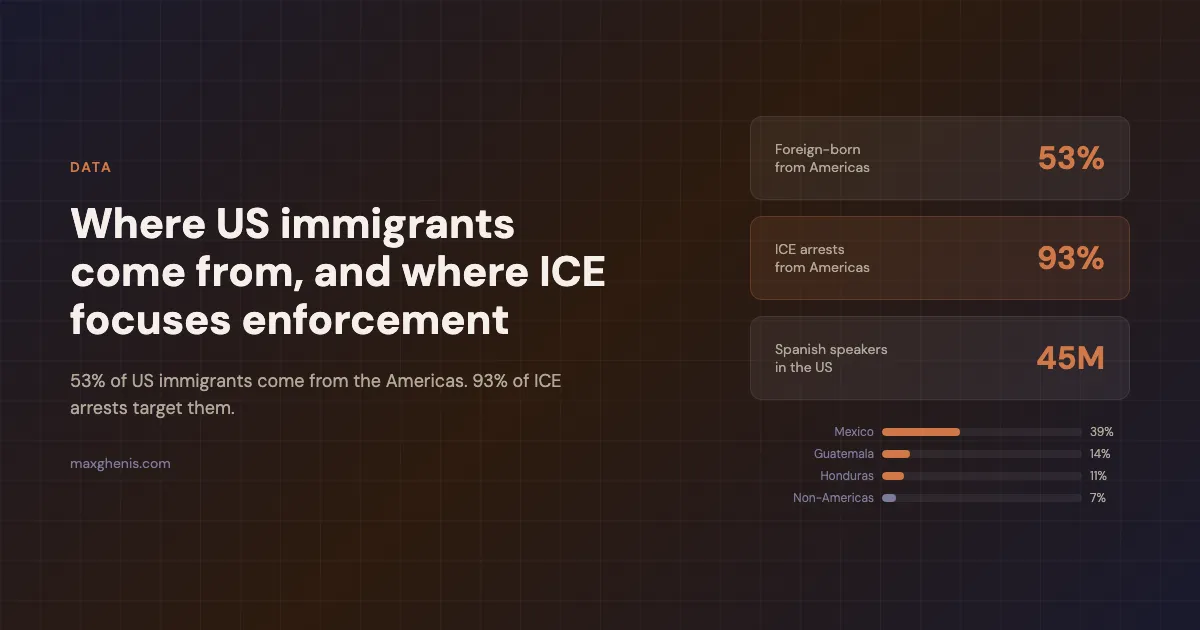
53% of the roughly 50 million foreign-born people in the United States come from other countries and territories in the American continent — Mexico alone accounts for 22% — according to the 2024 American Community Survey. Every country Bad Bunny named on that stage falls within that share.
Spanish is the most common non-English language
Bad Bunny performed entirely in Spanish and said during the show: “English wasn’t my first language, but that’s OK — it wasn’t America’s either.” Spanish is the most common non-English language in the United States, spoken at home by about 45 million people, about 14% of the US population. Of the 74 million people who speak a non-English language at home, 61% speak Spanish, per 2024 ACS data.
Congress has never passed a law designating an official language. In March 2025, Executive Order 14224 designated English as the official language and revoked EO 13166, a 2000 Clinton-era order that directed agencies to improve access for people with limited English proficiency. However, the order also states that agencies are “not required to amend, remove, or otherwise stop production of documents…in languages other than English.”
At the time of the first US census in 1790, about 86% of the white population was of British Isles descent (English, Welsh, Scottish, or Irish), with German (9%), Dutch (3%), and French (2%) communities making up much of the rest. The census also counted roughly 700,000 enslaved people — most American-born by that point — and excluded most Native Americans, who spoke over 300 languages at the time of European contact. Among the counted population, English was the dominant language, though German-speaking communities in Pennsylvania were large enough that bilingual government documents were common. Spanish-speaking settlers founded St. Augustine in 1565, 42 years before the first permanent English settlement at Jamestown.
ICE enforcement is concentrated in the Americas
While the foreign-born population is 53% from the Americas, ICE enforcement skews more heavily toward those countries.
Official ICE data shows that 98-99% of ICE administrative arrests from FY2021 through Q1 FY2025 involved people from other countries in the Americas. The UC Berkeley Deportation Data Project, which publishes record-level FOIA’d arrest data, provides a more granular look: from January 20 to October 15, 2025, 92.6% of 220,931 arrests involved nationals of countries in the Americas, with Mexico (38.6%), Guatemala (14.1%), and Honduras (11.0%) as the top three countries.
A UCLA Luskin study found that about 90% of ICE arrests during the first six months of Trump’s second term involved nationals of Latin American countries, using the same Berkeley FOIA data.
This concentration likely reflects the composition of the unauthorized population, which skews more heavily Latin American than the foreign-born population as a whole, as well as geographic proximity and enforcement priorities.
Operation Metro Surge in Minnesota
In December 2025, DHS launched Operation Metro Surge in Minneapolis, which it called the largest immigration enforcement operation ever, deploying up to 2,000 federal agents to the Twin Cities.
DHS said the operation focused on fraud in the Somali-American community. Minnesota is home to the largest Somali population in the US — roughly 84,000 people in the Twin Cities alone. Of those, nearly 58% were born in the United States, and of the foreign-born Somalis in Minnesota, 87% are naturalized US citizens, according to Census data reported by PBS.
Key outcomes of the operation:
- 3,000+ people arrested as of January 19, 2026, per DHS
- 23 arrestees were from Somalia, while the operation’s stated focus was on Somali fraud (Britannica). Nationally, 118 of 220,931 ICE arrests (0.05%) from January 20 to October 15, 2025 involved Somali nationals, per the UC Berkeley Deportation Data Project
- About 5% of arrestees had violent criminal records (Britannica)
- Two US citizens were killed by federal agents during the operation: Renee Good and Alex Pretti (CBS News)
- 50,000 people gathered on January 23 for a statewide general strike in protest (Britannica)
Sahan Journal reported effects on daily life in affected communities, including residents skipping medical appointments, reduced mosque attendance, and hundreds of businesses closing. Minnesota and the Twin Cities filed a federal lawsuit against DHS.
Summary
A majority of foreign-born people in the United States — 53% — come from other countries in the Americas. ICE enforcement is even more concentrated, with over 92% of arrests in 2025 involving nationals of countries in the Western Hemisphere. The largest enforcement operation, in Minnesota, was focused on the Somali community but resulted in over 3,000 arrests across nationalities.
Bad Bunny’s halftime show put a spotlight on the hemispheric connections between the US and the rest of the Americas. The immigration and enforcement data provide context for the scale of those connections.